I started a Twitter feed when I was working at OpenSesame as its marketing automation manager and used it to keep track of elearning and online training articles. At first, it was fun getting other users in the elearning industry to follow me back and I even won a really fancy box of donuts for my workplace for participating in a social media promotion for promoting a company's webinar.
That aside, I've taken a more hardline approach to managing this feed. I've gone beyond the simple follow and unfollow.
The rules of Twitter feed @SerenaHsiMktg:
If you are a Social Media follower seller - you get muted, not followed
If you are tweeting in a non-English language - followed and muted
Porn stars - muted, not followed
All followers followed have retweets turned off
Lately I've noticed that a lot of users with more than 5k followers are stacking their follower numbers by following and unfollowing other users, hoping that other users are not as vigilant as they are in unfollowing. This gives the Twitter community the impression that the one with the most followers has the most reach; which, in part is very true.
Follow me, I follow you back
Follow me, I follow you, unfollow me, I unfollow and mute you
Follow me again and I unfollow and block you (because you are already muted, I can see that you are trying to stack your follower count)
There are paid add-ons that do some of these steps, but not for repeat visit follows requests. For now I'll just manage this feed monthly or whenever I get around to it. Costs me about 10 minutes--which does add up over the course of a year. Maybe I should consider using an app add-on with automated settings to manage follows and unfollows.
And all those Twitter in-app messages? I don't read any of them.
Is there a goal for this feed? Probably not. Though, I've expanded article links to include all business and technology topics that are interesting. It just is a feed of what I happen to be reading at the time.
Showing posts with label social media. Show all posts
Showing posts with label social media. Show all posts
Klout and Unnatural Ranking
Klout started a while ago as a reputation ranking tool for users (and corporations) of social media. I only have one social property tied to Klout and as such, my Klout score is pitifully anemic (holding steady at 41, for just signing up and doing nothing much at all). I started looking at the scores of public figures and companies and then it dawned onto me that these entities have teams and a multitude of people contributing to and managing this score. Which really seems vastly unfair to those of us who represent small businesses. Sure, there might be a tinge of anger in this post; but I assure you it's for good reason.
Klout does nothing for my business. It doesn't help me generate leads or create new business opportunities; nor does it do anything for my clients who share the same online space on social media platforms. Klout doesn't even help a business gauge how well they are liked by customers who have purchased products or used their services. It's a useless "reputation" score that's generated by how frequent you post to your social network across multiple social networks. Seriously, neither I nor my followers and readers need that level of spam in our lives.
What bothers me is the inconsistency of how scores are calculated. It begs the question of today's random sceenshot:
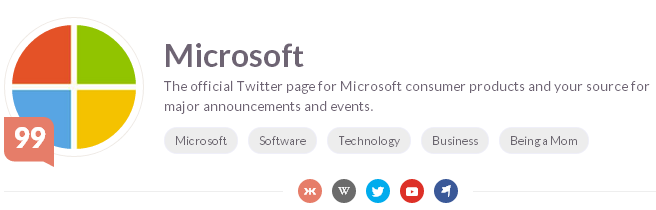 How many tags does it take to get the phrase "Being a Mom" associated with Microsoft's Klout score? That's what I want to know.
Klout does nothing for my business. It doesn't help me generate leads or create new business opportunities; nor does it do anything for my clients who share the same online space on social media platforms. Klout doesn't even help a business gauge how well they are liked by customers who have purchased products or used their services. It's a useless "reputation" score that's generated by how frequent you post to your social network across multiple social networks. Seriously, neither I nor my followers and readers need that level of spam in our lives.
What bothers me is the inconsistency of how scores are calculated. It begs the question of today's random sceenshot:

Vizify's Twitter Video
This neat tool allows Vizify users to create a short video clip of what makes up your Twitter feed. I used my @nwfood calendar feed to create this one:

The biggest downside to this is not being able to share the video directly to other social media platforms, like say Google+, Facebook, or practically everywhere else outside Vizify's ecosystem.
The biggest downside to this is not being able to share the video directly to other social media platforms, like say Google+, Facebook, or practically everywhere else outside Vizify's ecosystem.
Social Media Metrics for NonProfits - Facebook
It would appear that the only engagement lift this nonprofit association gets is when posts are promoted for recruitment or to get members and non-members to participate in an activity, and by promoted, I mean to say that we have to pay Facebook a scaled nominal fee each time we want to promote an event. The worthwhile metrics aren't tied to views, reach or engagements; but rather followers who become active, paid members; and subsequently those who renew their membership status year-over-year.
When I joined this professional association group at the start of the year, we had just over 1,500 followers. We now have roughly 1,890 followers; though no real data to benchmark how we are gaining or losing followers, e.g., as a result of event or new membership promotions.
The table for engagement by latest posts pretty much tell you what common sense tells you. Compared to the total reach (number of followers), the individual posts have practically no traction with our members. And, the only times when we show some measure of reach is when we pay to promote certain event posts.
One thing to watch out for is how your whole community page or association page is setup on Facebook, because in the above example with the latest posts, you might be the administrator and manage access; but you won't have any access to detailed reports if you didn't setup the promotion yourself. Now, tell me Facebook, how is that sane?
When I joined this professional association group at the start of the year, we had just over 1,500 followers. We now have roughly 1,890 followers; though no real data to benchmark how we are gaining or losing followers, e.g., as a result of event or new membership promotions.
 |
| Facebook's default report dashboard |
 |
| Facebook's default report dashboard for latest posts |
One thing to watch out for is how your whole community page or association page is setup on Facebook, because in the above example with the latest posts, you might be the administrator and manage access; but you won't have any access to detailed reports if you didn't setup the promotion yourself. Now, tell me Facebook, how is that sane?
 |
| A typical reporting error in Facebook. It begs the question, why can't all admins see the same reports? |
Bait and Switch
Southwest Airlines' March Facebook campaign is currently promoting $59 one-way flights. Except, I can't fly out from a major metro area to another major metro area for that price. And while $93/flight is a good price, it's not even close to the sweet FB deal. This is a good way to tick off customers who aren't loyal to the brand. What's worse is that the landing page that houses this offer has the cities in alphabetical order; a logical way to default sort it, but the flight prices are so not on "sale" for most one-way flights. I feel like I've been misled, again, by a deceptive sponsored ad.
The sponsored ad starts pretty well with all the right components in it that communicate brand, offer, and a call-to-action.
 |
| Sponsored Ad screenshot, 2013-03-08 |
 |
| Landing page mirrors the FB-pushed ad. Good right? Keep scrolling down... |
 |
| If Southwest had used regional ad targeting on FB, I would not have been pitched this offer. Maybe? One could only hope social media ad tech advances to this level. |
Target Ad Audience and Branding
I don't follow football, or much of sports for that matter except for the Olympics. The only time to tune in for Superbowl Sunday is to watch the cacophony of ads. At $4 million per 30 second slot, this is all the more reason to make whatever message your company wants to convey really count. Instead of harping on the truly terribly ads, I thought I might point out ones that really captured my attention. Movie previews are excluded. I looked at things like:
Worth Mentioning to Others:
Budweiser: Clydesdales "Brotherhood" - 9.3 million views on YouTube (budweiser)
Jeep: Whole Again with Oprah narration - 1.3 million views (thejeepchannel)
Skechers: Man vs Cheetah - 335k views (skechersperformance)
Audi: Prom - 9.2 million views (audiofamerica)
These ads had multichannel flair, presumably to drive the audience from TV to social media.
Oreo: Whisper Fight - 1.1 million views (oreo); Choose you side at Instagram (2200 followers before ad aired, post-Sunday almost 50k followers); would have a higher impact if the Instagram purl was advertised
Budweiser: Clydesdales "Brotherhood" - Name the baby Clydesdale (Hope and Stan), tweet name using #clydesdales @budweiser
Speed Stick:Unattended Laundry - 1.1 million views (speedstick); Tweet your #handleit moment
- Core (corporate) message or product brand easily understood?
- Speaks value to the right audiences?
- Feel good? Wacky? Clever?
- Did the end of the ad drive another campaign action?
Worth Mentioning to Others:
Budweiser: Clydesdales "Brotherhood" - 9.3 million views on YouTube (budweiser)
Jeep: Whole Again with Oprah narration - 1.3 million views (thejeepchannel)
Skechers: Man vs Cheetah - 335k views (skechersperformance)
Audi: Prom - 9.2 million views (audiofamerica)
These ads had multichannel flair, presumably to drive the audience from TV to social media.
Oreo: Whisper Fight - 1.1 million views (oreo); Choose you side at Instagram (2200 followers before ad aired, post-Sunday almost 50k followers); would have a higher impact if the Instagram purl was advertised
Budweiser: Clydesdales "Brotherhood" - Name the baby Clydesdale (Hope and Stan), tweet name using #clydesdales @budweiser
Speed Stick:Unattended Laundry - 1.1 million views (speedstick); Tweet your #handleit moment
Best App Deployments of 2011
Google+ Hangouts enable free audio/visual conference calling with a group of up to 10 people. There's a 45-minute timer on the hangouts, so if you intend to be on it for longer than that, be sure there's a warm body who can let the app know that you're still around even when you're busy cooking up a holiday dinner. Check out the "Hangouts with extras" beta features.
Amazon's Price Check lets shoppers at brick and mortar retailers use a smart device (iPhone, Android O/S) to enter the barcode of an item and purchase it from Amazon.com with a $5-off incentive. This takes comparison shopping to a whole new handheld level.
Move over iPen. Wacom has you beat with its Bamboo Paper app (for desktop or iPad) and its ergonomically-designed stylus for the iPad. Not only does it handle notetaking with handwriting recognition, it can also be used for sketching and presenting notes, ideas and sketches with others. Download these from Wacom's Bamboo Dock.
JPM Chase and Wells Fargo are among the front runners of the banking industry that are creating apps to make it easier for customers to transact with them using smartphone apps. Wells Fargo's Mobile Banking app allows users to check their available balances, view account activity, pay bills, make transfers between accounts or to other Wells Fargo customers, and locate the nearest Wells Fargo or Wachovia ATMs and office locations from an iPhone, iPod Touch or iPad. Chase QuickDeposit allows customers to deposit checks with an iPhone, iPad or Android device with just two camera clicks. Whatever online banking features customers already use to manage their finances with desktop systems, the momentum within the banking industry for secure, mobile banking apps is bound to increase significantly.
Happy Star Rewards (available on iPhone and Android platforms), a location-based rewards app by parent company CKE Restaurants, invites users to check in when they dine at either Carl's Jr or Hardee's. The first check in earns the user a spin on the "Wheel of Awesome" for a chance to win free or discounted food, gift cards, and merchandise from participating partners. Winners can immediately redeem the prize or within seven days. While the location-based app released early last year, it still totally one-ups Foursquare, Facebook Places, and other check in apps. File this one under retention marketing.
Runner-ups:
Unable to sell off its mobile operating system webOS and no longer a manufacturer of the tabletware that houses this code, HP's webOS and its support resources are now part of the open source community where devs can use and modify freely.
Popplet, a web-based collaborative mindmapping tool. Think of popples as little buckets containing text, photos, and whatever else people share online. Free version only allows you to edit one popplet and the paid version allows you to create unlimited popplet. Downsides: Flash-based for desktop computers, still in beta, clunky interface.
CarrierIQ's hidden app collects device performance data from millions of Android, Blackberry, and Nokia mobile phones. Is that really a bad thing? What R&D entity wouldn't want to know more about their users and how their devices are being used? It is a gray area in US wire tapping laws since CarrierIQ's app engages in passive wiretapping for monitoring/recording data traffic. Unless these class action lawsuits can prove that CarrierIQ deliberately altered the traffic with the app, there's really not much that any user can do about it besides buy a mobile phone that doesn't have CarrierIQ's rootkit installed such as a Windows 7 Phone. So it tracks location data, big deal. How else would a mobile device be able to triangulate the best celltower reception or allow a user to check into their favorite retail shop?
Amazon's Price Check lets shoppers at brick and mortar retailers use a smart device (iPhone, Android O/S) to enter the barcode of an item and purchase it from Amazon.com with a $5-off incentive. This takes comparison shopping to a whole new handheld level.
Move over iPen. Wacom has you beat with its Bamboo Paper app (for desktop or iPad) and its ergonomically-designed stylus for the iPad. Not only does it handle notetaking with handwriting recognition, it can also be used for sketching and presenting notes, ideas and sketches with others. Download these from Wacom's Bamboo Dock.
JPM Chase and Wells Fargo are among the front runners of the banking industry that are creating apps to make it easier for customers to transact with them using smartphone apps. Wells Fargo's Mobile Banking app allows users to check their available balances, view account activity, pay bills, make transfers between accounts or to other Wells Fargo customers, and locate the nearest Wells Fargo or Wachovia ATMs and office locations from an iPhone, iPod Touch or iPad. Chase QuickDeposit allows customers to deposit checks with an iPhone, iPad or Android device with just two camera clicks. Whatever online banking features customers already use to manage their finances with desktop systems, the momentum within the banking industry for secure, mobile banking apps is bound to increase significantly.
Happy Star Rewards (available on iPhone and Android platforms), a location-based rewards app by parent company CKE Restaurants, invites users to check in when they dine at either Carl's Jr or Hardee's. The first check in earns the user a spin on the "Wheel of Awesome" for a chance to win free or discounted food, gift cards, and merchandise from participating partners. Winners can immediately redeem the prize or within seven days. While the location-based app released early last year, it still totally one-ups Foursquare, Facebook Places, and other check in apps. File this one under retention marketing.
Runner-ups:
Unable to sell off its mobile operating system webOS and no longer a manufacturer of the tabletware that houses this code, HP's webOS and its support resources are now part of the open source community where devs can use and modify freely.
Popplet, a web-based collaborative mindmapping tool. Think of popples as little buckets containing text, photos, and whatever else people share online. Free version only allows you to edit one popplet and the paid version allows you to create unlimited popplet. Downsides: Flash-based for desktop computers, still in beta, clunky interface.
CarrierIQ's hidden app collects device performance data from millions of Android, Blackberry, and Nokia mobile phones. Is that really a bad thing? What R&D entity wouldn't want to know more about their users and how their devices are being used? It is a gray area in US wire tapping laws since CarrierIQ's app engages in passive wiretapping for monitoring/recording data traffic. Unless these class action lawsuits can prove that CarrierIQ deliberately altered the traffic with the app, there's really not much that any user can do about it besides buy a mobile phone that doesn't have CarrierIQ's rootkit installed such as a Windows 7 Phone. So it tracks location data, big deal. How else would a mobile device be able to triangulate the best celltower reception or allow a user to check into their favorite retail shop?
Psychology of Sharing, a NYT study
The Consumer Insight Group of the New York Times did a study on the Psychology of Sharing. Its content has disseminated in some form to various marketers involved with social media. If you were curious, these people are responsible for the "study" which has been quoted with the same subject title. A summary presentation appeared on SlideShare.
Methodology:
Observations:
Methodology:
- In-person interviews in major metropolitan areas (New York, Chicago, and San Francisco)
- Quantitative survey of 2,500 medium/heavy online sharers
Observations:
- Sharing is not new, but in the information age we share more content with more users from more sources with more people, more often and more quickly
- Sharing acts as information management
- 85% say reading other people's responses helps them understand and process information and events
- 73% say they process information more deeply, thoroughly and thoughtfully when they share it
Motivations for Sharing:
- To bring valuable and entertaining content to others
- To define ourselves to others
- To grow and nourish our relationships
- Self-fulfillment ("We enjoy getting credit for it")
- To get the word out about causes or brands
6 Personas of Sharing:
- Altruists - share content to be helpful to others, and aspire to be reliable sources of information; prefers email and Facebook
- Careerists - well-educated sharers want to earn a reputation for bringing value to their networks, preferring content that is more serious and professional in tone; prefers LinkedIn and email
- Hipsters - younger sharers “have only known life in the information age” and share cutting-edge and creative content, and they focus on identity-building; prefers Twitter and Facebook
- Boomerangs - sharers after validation and will respond to positive or negative responses; no strong preference but will share using Facebook, email, Twitter, and blogs
- Connectors - sees content sharing as a way to stay connected with others and make plans; prefers email and Facebook
- Selectives - put more thought into what they share and with whom they share it. Because their sharing is more personalized, they expect people to respond to and act on their content; Prefers email
I actually laughed at this part of the study: Email is the #1 factor that influences sharing since it's perceived as more personal and private.
Intuit's Love a Local Business Promo
If you didn't already know how to promote your business using social media sites like Facebook and Twitter, Intuit incentively recruits newcomers by offering a $25,000 small business grant each month.

How it works:
A business owner nominates their business (based on company name and location) through Intuit's sign-up page (if the company name doesn't appear, e.g., if you're not registered with your city with an active business license or lack a D&B DUNS number, you can still nominate your business by filling in the appropriate information where prompted. Manual nominations will not show up on the locations map, but do count as valid votes).
If you are concerned about spam and privacy when posting your contact information; say, you have a home-based business. Sign up with Google Voice using your existing mobile or landline telephone number and get an Internet number assigned to it. That way you can collect legitimate business inquiries via Google Voice voicemail. Get a PO Box from your local post office, or a 3rd party mailbox service. If you happen to pair the PO Box with your home address, it will really confuse data processors for direct (junk) mail. But, make sure that Intuit is able to contact you, regardless. Banks and clearing houses use the POB method for marketing campaign targeting, you could too.
Local fans of the business can vote for you. Each vote counts as a raffle ticket. If you look at the previous months' results, Mid-Michigan Kennels won with only 1341 votes.
Deadline for submitting nominations/votes: September 30, 2011
Geospatial Tweet Mapping
I have this love-hate relationship going on with Twitter. For starters, I hate the disproportionate amount of time it takes to manage the site for the value it creates. Marketers struggle with how much more time it takes to analyze campaign data (leads generated, mentions, retweets, followers gained, referrals, etc.) that uses Twitter as a communication channel to decide whether or not to employ the same techniques again for future campaigns. I love how the concept spurred lots of 3rd party app creators to make life easier using Twitter.
The idea that 140-character feeds could be so time consuming to manage and aggregate into meaningful data points is a challenge for most online marketers. The more apps that are created, the lazier marketers get in dealing with data. Like a multiverse gaming console, I just want a one-stop-aggregator for multiple platforms.. which means the ultimate, master API that thinks for itself, automatically adjusts to accept new connections and ports many data formats into one cloud repository. The latter incarnations actually exist. For now, we have to rely on and contend with the more sluggish, manual human interface.
Because the public sector is always shorthanded, much of the data aggregation comes from outside sources using non-standard perimeters. Even how coordinates are stored have three or four different formats. Ever look at a physical topo map for hiking? The degree and UTM systems are both listed. Google Maps uses the decimal system. Anyhow. Geospatial analysis (GIS) typically refers to sets of longitude/latitude location markers designated to individual data points and was originally developed to help solve problems in environmental and life sciences, ecology, geology, and epidemiology. It has expanded to include a lot more industries like defense, intelligence, utilities, natural resources, social sciences, public safety, etc. Marketers use geospatial data to target customer segments that are based in certain zip codes, cities, or metropolitan areas, though largely for direct marketing efforts.
Here are a few geospatial web tools for Twitter trend watching:
The idea that 140-character feeds could be so time consuming to manage and aggregate into meaningful data points is a challenge for most online marketers. The more apps that are created, the lazier marketers get in dealing with data. Like a multiverse gaming console, I just want a one-stop-aggregator for multiple platforms.. which means the ultimate, master API that thinks for itself, automatically adjusts to accept new connections and ports many data formats into one cloud repository. The latter incarnations actually exist. For now, we have to rely on and contend with the more sluggish, manual human interface.
Because the public sector is always shorthanded, much of the data aggregation comes from outside sources using non-standard perimeters. Even how coordinates are stored have three or four different formats. Ever look at a physical topo map for hiking? The degree and UTM systems are both listed. Google Maps uses the decimal system. Anyhow. Geospatial analysis (GIS) typically refers to sets of longitude/latitude location markers designated to individual data points and was originally developed to help solve problems in environmental and life sciences, ecology, geology, and epidemiology. It has expanded to include a lot more industries like defense, intelligence, utilities, natural resources, social sciences, public safety, etc. Marketers use geospatial data to target customer segments that are based in certain zip codes, cities, or metropolitan areas, though largely for direct marketing efforts.
Here are a few geospatial web tools for Twitter trend watching:
- Twitter API for geolocation
- Landsat Data for the World by ESRI, a tweet mapping template
- OpenStreetMap, a free editable map of the world
- GPS Brand of Choice, using SurveyMapper
- Global McDonalds Big Mac Prices 2007, using MapTube
- City-based tweet counter, using Tweet-o-Meter
- Active Floods in the USA, using ArcGIS
What makes Goldstar Events different
Email marketing is not dead, really. Just ask the people who run Goldstar Events. Back in 2002, their email list only had 10,000 registered users on it. Today, it does about $40 million a year in ticket sales and has 1.2 million subscribers. The founding principle behind this privately held company is similar to Priceline.com, except it's for the entertainment sector and doesn't rely on a reverse auction system. The notion of "not every show sells out, so instead of letting seats go empty, venues list them with us to sell to our members" is what drives customers to buy up tickets at half price. Sometimes tickets are even free, but it's on a first come first served basis.
Goldstar's forte is having deals in major metropolitan areas. When I lived in Los Angeles, I thought it was a real treat to sit at the very front of a jazz or classical music concert. It just tickled me pink to see all the septo- and octogenarians wondering how I got there. They're still a little skinny on venues in the Portland metro area.
How a customer opts in for email through Goldstar was really well thought out. You can add and remove venues by zip code, and Goldstar will serve up content to your specifications. Even if you don't live in a metro area, you can still buy tickets for other people. All they need to do is show the ticket registration (which, by the way is delivered by email to you and to your guest) at the venue's ticket counter with a photo ID and they're all set. Newsletter spam too much for you? Simply log into the site and turn it off for a while. Your venue interests will still be there if you want to see what's going on in your metro area.
Here is a shameless plug for my referral link, if you wanted to subscribe. Every referral earns me a service fee credit. Even at half off a ticket, Goldstar charges a small, but fair fee per ticket purchased. This is how they make money to run the site. It's still a lot better than paying full price.
Sure, they have joined the social media platform bandwagon, but they have never lost sight of their core strengths in this market and whatever additional buzz is created by Facebook and Twitter, it can only help to create more mindshare about their services.
Goldstar's forte is having deals in major metropolitan areas. When I lived in Los Angeles, I thought it was a real treat to sit at the very front of a jazz or classical music concert. It just tickled me pink to see all the septo- and octogenarians wondering how I got there. They're still a little skinny on venues in the Portland metro area.
How a customer opts in for email through Goldstar was really well thought out. You can add and remove venues by zip code, and Goldstar will serve up content to your specifications. Even if you don't live in a metro area, you can still buy tickets for other people. All they need to do is show the ticket registration (which, by the way is delivered by email to you and to your guest) at the venue's ticket counter with a photo ID and they're all set. Newsletter spam too much for you? Simply log into the site and turn it off for a while. Your venue interests will still be there if you want to see what's going on in your metro area.
Here is a shameless plug for my referral link, if you wanted to subscribe. Every referral earns me a service fee credit. Even at half off a ticket, Goldstar charges a small, but fair fee per ticket purchased. This is how they make money to run the site. It's still a lot better than paying full price.
Sure, they have joined the social media platform bandwagon, but they have never lost sight of their core strengths in this market and whatever additional buzz is created by Facebook and Twitter, it can only help to create more mindshare about their services.
Future of Social Media
Like just about everything in a marketer's world, social media isn't exactly a trend or a fad, but it too will fade into being just another channel a marketer has to deal with; whether as a consultant advising his/her clients on the strategic advantage of maintaining a presence on community-centered websites, or building campaigns to drive revenues and sales lead conversions.
The world of social media as we know it and its associated terminology like "social analytics" "having a conversation with customers" will go away. It'll be back to just multichannel analytics with social being one of the many potential channels an organization can use for ROI or KPI metrics, and social being a casual, normal way to conduct business online, in wifi, or in some collaborative medium that has yet to be defined.
/soapbox
The world of social media as we know it and its associated terminology like "social analytics" "having a conversation with customers" will go away. It'll be back to just multichannel analytics with social being one of the many potential channels an organization can use for ROI or KPI metrics, and social being a casual, normal way to conduct business online, in wifi, or in some collaborative medium that has yet to be defined.
/soapbox
Paperless Coupons & Loyalty Marketing
Coupons sure are a hot topic this year with all the display ads being clogged up utilized by online properties such as Groupon, LivingSocial, DailyDeals, etc. But, what about the long-standing purveyors of coupons.. the grocery store?
As far as I can tell, there are two types of paperless coupons:
a) the digitized version of the coupon that you show to the clerk at a store to be scanned using your mobile or smartphone, and
b) the coupons that users can elect to sign-up for and push to a rewards/loyalty card offered by a particular merchant like Fred Meyers (or any of the Kroger grocery stores with loyalty cards).
The biggest hurdle for the "b" group is consumer awareness. Using a loyalty card has bee pretty straightforward. You go into a store responding to either an in-store ad promotion or one from the weekly circular, match your product and get a discount when you fulfill the offer's requirements. It's a tiny, innoculous keyfob that just hangs there with all the other micro loyalty cards. Every merchant from the pet shop to the grocery store to the local coffee house to the corner drugstore wants a piece of the action in your pocketbook. Very few loyalty cards actually require you to do anything transactional on a merchant's website. Three notable firms that come to mind are: Starbucks (have to register and setup a user account to add more bucks to a Starbucks card, check card balance), REI (stores member details that can be accessed in-store or online at rei.com), and Fred Meyers (via the Kroger parent brand, has a very thought-out loyalty program but few are aware of it).
The following statistic picked up by Internet Retailer is a minor annoyance to how one should use a research data point.
"49% of loyalty program members never or rarely take advantage of loyalty program perks when shopping online; however, 78% of Americans who are members of loyalty card programs say easy online access to their loyalty memberships would make them more likely to shop at the retail web sites that honor their loyalty programs." --a study by ACI Worldwide, on electronic payments and rewards programs.
It really should have started out this way, "51% of loyalty program members take advantage of loyalty program perks when shopping online..." Heck, that's more than half! If ACI had stats from the prior years, they could have let on if this number is growing or shrinking. So anyways...
Like mindshare, there is limited space on your keyfob or in your wallet for additional loyalty cards. Typically, the cards that offer the best rewards are the ones that consumers put up with and carry them around everywhere. Having a customer to opt-into the card is the easy part. Getting them to proactively load their own card with preferred offers with the benefit of not having to print out the coupons is a considerable shift in a consumer's perception about coupons. How these offers are redeemed is no different than swiping the loyalty card at checkout. FM makes it pretty easy for customers to access information about their loyalty card account. No paper clippings are necessary.

FM uses an app called SoftCoin to host merchant offers for digital coupons, which is run by a bi-coastal company called YOU Technology. I think they've gotten pretty good at targeting and pairing offers to consumers. If FM is going to rise from being the #3 grocery retailer in the US, the way technology impacts both consumers and how users get informed about product offers will certainly make a difference.
As far as I can tell, there are two types of paperless coupons:
a) the digitized version of the coupon that you show to the clerk at a store to be scanned using your mobile or smartphone, and
b) the coupons that users can elect to sign-up for and push to a rewards/loyalty card offered by a particular merchant like Fred Meyers (or any of the Kroger grocery stores with loyalty cards).
The biggest hurdle for the "b" group is consumer awareness. Using a loyalty card has bee pretty straightforward. You go into a store responding to either an in-store ad promotion or one from the weekly circular, match your product and get a discount when you fulfill the offer's requirements. It's a tiny, innoculous keyfob that just hangs there with all the other micro loyalty cards. Every merchant from the pet shop to the grocery store to the local coffee house to the corner drugstore wants a piece of the action in your pocketbook. Very few loyalty cards actually require you to do anything transactional on a merchant's website. Three notable firms that come to mind are: Starbucks (have to register and setup a user account to add more bucks to a Starbucks card, check card balance), REI (stores member details that can be accessed in-store or online at rei.com), and Fred Meyers (via the Kroger parent brand, has a very thought-out loyalty program but few are aware of it).
The following statistic picked up by Internet Retailer is a minor annoyance to how one should use a research data point.
"49% of loyalty program members never or rarely take advantage of loyalty program perks when shopping online; however, 78% of Americans who are members of loyalty card programs say easy online access to their loyalty memberships would make them more likely to shop at the retail web sites that honor their loyalty programs." --a study by ACI Worldwide, on electronic payments and rewards programs.
It really should have started out this way, "51% of loyalty program members take advantage of loyalty program perks when shopping online..." Heck, that's more than half! If ACI had stats from the prior years, they could have let on if this number is growing or shrinking. So anyways...
Like mindshare, there is limited space on your keyfob or in your wallet for additional loyalty cards. Typically, the cards that offer the best rewards are the ones that consumers put up with and carry them around everywhere. Having a customer to opt-into the card is the easy part. Getting them to proactively load their own card with preferred offers with the benefit of not having to print out the coupons is a considerable shift in a consumer's perception about coupons. How these offers are redeemed is no different than swiping the loyalty card at checkout. FM makes it pretty easy for customers to access information about their loyalty card account. No paper clippings are necessary.

FM uses an app called SoftCoin to host merchant offers for digital coupons, which is run by a bi-coastal company called YOU Technology. I think they've gotten pretty good at targeting and pairing offers to consumers. If FM is going to rise from being the #3 grocery retailer in the US, the way technology impacts both consumers and how users get informed about product offers will certainly make a difference.
Cyber Monday / Black Friday Report 2010
Coremetrics, an IBM company, just released its benchmark cyber monday / black friday report for 2010. For those of you who don't work in retail, online or in a brick-n-mortar storefront, cyber monday refers to the first Monday after Thanksgiving weekend, and Black Friday is the day after Thanksgiving, supposedly among the busiest online and offline shopping days of the year as many retailers try to capture their 80% of annual revenues before the end of the year.
Here are some of the stats from the report:
Cyber Monday 2010 vs Cyber Monday 2009 (year/year):
Consumer Spending Increases: Online sales were up 19.4 percent, with consumers pushing the average order value (AOV) up from $180.03 to $194.89 for an increase of 8.3 percent.
Luxury Goods Report Big Gains: Affluent shoppers opened their wallets wide, driving sales of luxury goods up 24.3 percent over 2009.
Shopping Peaks at 9:00 am PST/Noon EST: Consumers flocked online, with shopping momentum hitting its peak at 9:00 am PST/noon EST. But consumer shopping maintained stronger momentum throughout the day than on Cyber Monday 2009.
How people shop shows more than a willingness to do business online; it also shows the level of comfort that users have with transferring financial data over an unsecured, wireless network. Two notable trends of holiday season 2010 are:
Social Shopping: The growing trend of consumers using their networks on social sites for information about deals and inventory levels continued on Cyber Monday. While the percentage of visitors arriving from social network sites is fairly small relative to all online visitors—nearly 1 percent—it is gaining momentum, with Facebook dominating the space.
Mobile Shopping: Consumers continue to use mobile as a shopping tool. On Cyber Monday, 3.9 percent of people visited a retailer’s site using a mobile device.
Afterthoughts:
I thought that there would be a bigger difference in YOY stats among all the retail channels--mobile, web, in-store, etc., but there weren't. 2010 did slightly better than 2009 and on average, the segments performed about the same as the prior year.
Health and Beauty segment performed the best overall with the highest new visitor conversion rate (5.94%) and the lowest cart abandonment rate (59.74%). The Jewelry segment had the highest average order ($384.25) with the fewest number of items per order (1.57). Department stores are still lagging behind all other segments with the highest cart abandonment (76.98%), though this could be due to any number of reasons (poor user interface, unsecured web forms, price not right, timing not right for the consumer, the deal just wasn't sweet enough, first time customer unwilling to trust retailer with financial information, etc.).
What isn't covered in the report is the methodology used and the companies used to generate these stats.
Bounce rate is relatively low for the US retail market which means that via web/email/mobile, relevant messaging was used to entice a consumer to a point-of-sale action. Higher bounce rate typically indicates blogs (doesn't take much time for people to skim through text), irrelevant search keyword hits, or the wrong offer was used with an attractive call-to-action from an email or mobile message.
eCommerce can be more profitable than other sales or partner retail channels, especially if your website is managed in-house. Profit margin tends to be higher, operating costs are presumably lower, and if it is a well-oiled machine, you don't pay your website double time to work through the holidays.
Also, the more shopping that's done on cyber monday, the less they are doing actual work at work.
Read the report
Coremetrics' executive summary
Here are some of the stats from the report:
Cyber Monday 2010 vs Cyber Monday 2009 (year/year):
Consumer Spending Increases: Online sales were up 19.4 percent, with consumers pushing the average order value (AOV) up from $180.03 to $194.89 for an increase of 8.3 percent.
Luxury Goods Report Big Gains: Affluent shoppers opened their wallets wide, driving sales of luxury goods up 24.3 percent over 2009.
Shopping Peaks at 9:00 am PST/Noon EST: Consumers flocked online, with shopping momentum hitting its peak at 9:00 am PST/noon EST. But consumer shopping maintained stronger momentum throughout the day than on Cyber Monday 2009.
Cyber Monday 2010 | Items Per Order | Avg Order | Cart Abandonment | New Visitor Conv. Rate |
| US Retail | 6.41 | $194.89 | 63.68% | 4.41% |
Apparel | 2.36 | $128.13 | 65.32% | 3.20% |
Dept Stores | 3.03 | $117.49 | 76.98% | 2.90% |
Health & Beauty | 4.20 | $68.30 | 59.74% | 5.94% |
Jewelry | 1.57 | $384.25 | 67.73% | 1.02% |
Sport Apparel & Gear | 3.02 | $120.60 | 72.78% | 2.19% |
How people shop shows more than a willingness to do business online; it also shows the level of comfort that users have with transferring financial data over an unsecured, wireless network. Two notable trends of holiday season 2010 are:
Social Shopping: The growing trend of consumers using their networks on social sites for information about deals and inventory levels continued on Cyber Monday. While the percentage of visitors arriving from social network sites is fairly small relative to all online visitors—nearly 1 percent—it is gaining momentum, with Facebook dominating the space.
Mobile Shopping: Consumers continue to use mobile as a shopping tool. On Cyber Monday, 3.9 percent of people visited a retailer’s site using a mobile device.
Afterthoughts:
I thought that there would be a bigger difference in YOY stats among all the retail channels--mobile, web, in-store, etc., but there weren't. 2010 did slightly better than 2009 and on average, the segments performed about the same as the prior year.
Health and Beauty segment performed the best overall with the highest new visitor conversion rate (5.94%) and the lowest cart abandonment rate (59.74%). The Jewelry segment had the highest average order ($384.25) with the fewest number of items per order (1.57). Department stores are still lagging behind all other segments with the highest cart abandonment (76.98%), though this could be due to any number of reasons (poor user interface, unsecured web forms, price not right, timing not right for the consumer, the deal just wasn't sweet enough, first time customer unwilling to trust retailer with financial information, etc.).
What isn't covered in the report is the methodology used and the companies used to generate these stats.
Bounce rate is relatively low for the US retail market which means that via web/email/mobile, relevant messaging was used to entice a consumer to a point-of-sale action. Higher bounce rate typically indicates blogs (doesn't take much time for people to skim through text), irrelevant search keyword hits, or the wrong offer was used with an attractive call-to-action from an email or mobile message.
eCommerce can be more profitable than other sales or partner retail channels, especially if your website is managed in-house. Profit margin tends to be higher, operating costs are presumably lower, and if it is a well-oiled machine, you don't pay your website double time to work through the holidays.
Also, the more shopping that's done on cyber monday, the less they are doing actual work at work.
Read the report
Coremetrics' executive summary
The "in" crowd
Probably the most annoying phrase heard this year is "joining the conversation," as in, businesses actually responding to customer comments, needs, and complaints via social media networks such as LinkedIn, Facebook, and Twitter status updates, or by email/web campaigns.
That is so 1990.
Isn't listening to your customers one of the servicing fundamentals of doing for-profit business in the first place?
That is so 1990.
Isn't listening to your customers one of the servicing fundamentals of doing for-profit business in the first place?
Social Media for B2B
Disclosure: I am not a social media expert nor social media strategist. And, using social media for business promotion is debatable. But, like Twitter, it looks like the idea is here to stay until it evolves into something else. Frankly, I hate the rebranding of rebranding because it doesn't add new thoughts to the mix, rather it boils the thoughts into short 140-character statements that add little meaning beyond the initial insert. It's up to you to decide if these are indeed strategies and if they'll coexist with your marketing mix. Sooner or later, your business unit or department will be tasked with the question of whether or not to add social media to how you do business with customers.
On the B2B side, we used to call this word-of-mouth, relationship, grassroots, or brand ambassador marketing. Sounds pretty boring and low budget. These all have the same expected outcome. Get the customer to proactively self-identify, raise their hand, or ask for help directly from the business. "Social" has an incredibly positive connotation to it. Communication by words, visual imagery, video, sounds, or touch is all very human. Social media is the sharing of marketing and advertising content by a means of one-to-many relationships while at the same time disguises itself as a one-to-one relationship with a customer that the business wants to learn more about or nurture over time for future sales.
The synopsis is that social media implementation deals with a) knowing your customers and how they want to communicate with you about your products/services, b) the apps/hacks/and plug-ins that are used by the social media community, and c) building the right strategy for your business or business model.
Actions to consider:
On the B2B side, we used to call this word-of-mouth, relationship, grassroots, or brand ambassador marketing. Sounds pretty boring and low budget. These all have the same expected outcome. Get the customer to proactively self-identify, raise their hand, or ask for help directly from the business. "Social" has an incredibly positive connotation to it. Communication by words, visual imagery, video, sounds, or touch is all very human. Social media is the sharing of marketing and advertising content by a means of one-to-many relationships while at the same time disguises itself as a one-to-one relationship with a customer that the business wants to learn more about or nurture over time for future sales.
The synopsis is that social media implementation deals with a) knowing your customers and how they want to communicate with you about your products/services, b) the apps/hacks/and plug-ins that are used by the social media community, and c) building the right strategy for your business or business model.
Actions to consider:
- Know who your customer is: go where your customers go, read what they read, see the experience through their eyes
- Identify the path of least resistance for a customer to get a question resolved: postal mail, fax, telephone, web form, email, survey, social media status update
- Legal implications and privacy concerns over what is "said" by the business and what is "heard" by the customer
- Understand that the web is global and that inbound customer complaints might not even pertain to your trade region
- Establish ground rules for participants using the same social media outlets
- Build consensus across the organization of what should be achieved by adding social media to the existing marketing mix.
- Be able to quantify the benefits beyond mere number of followers, page views, or retweets
- Define your social media strategy plan
How customers actively engage with each other:
- By participating on a social network community (see Wikipedia for a comprehensive list)
- Video sharing
- Reading/writing/commenting with blogs
- Photo sharing
- Real-time (or fake time) status updates of what people are doing now
Here are some social media tools to help you manage your time:
- CoTweet - integrated with bit.ly, allows multiple users to post to one or more linked Twitter accounts, allows real-time or delayed Twitter updates, watch multiple conversations based on keywords
- Tweetdeck - allows simultaneous status updates on Twitter/Facebook/and LinkedIn
- Swix - easily create a unified scoreboard of all your key social media metrics (blog traffic, subscribers, FB fans, Twitter followers, YouTube subscribers, etc.)
- SlideShare - upload presentations and share online, tracks views http://www.slideshare.net/
- Icerocket - keyword search across blogs, web, Twitter, MySpace, News, images, etc.
In the end, businesses just want to create more meaningful conversations with their customers.
It begs the question, what does a conversation look like between say, Microsoft and a new Windows7 customer?
related articles:
related articles:
Overview: social media metrics
All this hubbub about social media marketing has prompted me to scour the web for what organizations are doing about implementing this as part of their customer life cycle management strategy. If this scenario hasn't happened in your workplace yet, it might some day and it's best to at least have a body of knowledge when your boss or client asks for your insight about this very topic.
For a top-level overview, poplabs has put together a pretty succinct presentation about social media metrics. The premise behind the slides is: how do you measure the impact of your social media marketing campaign?
According to poplabs, social media is supported on the techdev side by entities like YouTube, Technorati, FeedBurner, Wikipedia, LinkedIn, Facebook, VIRB, MySpace, twitter, Pownce, digg, del.icio.us, etc. There is a growing trend in the number of companies willing to adopt conversation marketing as a means to include customers in a product or service life cycle. Ultimately, this creates solid customer relationships because the customer believes they are not only being heard, but something is being done about it. Social media is an interrelational strategy that collaborates with and connects to web and internet marketing strategy.
Web strategy encompasses where customers get their news and information about a company's products and services. It should first be a solid, well developed website with all the necessary details a customer needs to perform a transaction, or as marketers call it, to respond to a call-to-action (e.g., customer fills out a contact form, requests more information or a demo, or purchases directly from the website).
Internet marketing strategy covers how the customers are pushed or pulled to website properties, whether it's by affiliate networks, banner ad exchanges, pay per click (PPC), search ads (SEO, SEM), or through online public relations efforts.
Social media enables customers to have an open feedback channel with a company, its core product groups, or with specific brands. It is supposed to use one-to-one relationships and personal-or-business social networks to succeed.
Influence and Engagement are two metrics that poplabs identifies as being the most important for social media. These concepts have always been around since the dawn of marketing where a person's influence traditionally drives referrals and cross-sell opportunities; and engagement is how far a referral is willing to become a lifetime customer of a particular product or service.
Tracking and measuring social media is also nothing new. This involves classic competitive intelligence where you look at key employees and CXOs, relevant industry sites, domains and urls, product/service names, product/service urls, tracking competitor activity for like products/services, insider activity, newsgroups, blog comments, etc.
For a top-level overview, poplabs has put together a pretty succinct presentation about social media metrics. The premise behind the slides is: how do you measure the impact of your social media marketing campaign?
According to poplabs, social media is supported on the techdev side by entities like YouTube, Technorati, FeedBurner, Wikipedia, LinkedIn, Facebook, VIRB, MySpace, twitter, Pownce, digg, del.icio.us, etc. There is a growing trend in the number of companies willing to adopt conversation marketing as a means to include customers in a product or service life cycle. Ultimately, this creates solid customer relationships because the customer believes they are not only being heard, but something is being done about it. Social media is an interrelational strategy that collaborates with and connects to web and internet marketing strategy.
Web strategy encompasses where customers get their news and information about a company's products and services. It should first be a solid, well developed website with all the necessary details a customer needs to perform a transaction, or as marketers call it, to respond to a call-to-action (e.g., customer fills out a contact form, requests more information or a demo, or purchases directly from the website).
Internet marketing strategy covers how the customers are pushed or pulled to website properties, whether it's by affiliate networks, banner ad exchanges, pay per click (PPC), search ads (SEO, SEM), or through online public relations efforts.
Social media enables customers to have an open feedback channel with a company, its core product groups, or with specific brands. It is supposed to use one-to-one relationships and personal-or-business social networks to succeed.
Influence and Engagement are two metrics that poplabs identifies as being the most important for social media. These concepts have always been around since the dawn of marketing where a person's influence traditionally drives referrals and cross-sell opportunities; and engagement is how far a referral is willing to become a lifetime customer of a particular product or service.
Tracking and measuring social media is also nothing new. This involves classic competitive intelligence where you look at key employees and CXOs, relevant industry sites, domains and urls, product/service names, product/service urls, tracking competitor activity for like products/services, insider activity, newsgroups, blog comments, etc.
Subscribe to:
Posts (Atom)