Showing posts with label retention marketing. Show all posts

Which Part of the Funnel Should You Focus On

What do you have control over? If you don't have any input into how SEO/SEM works for your company or maybe inbound leads are driven by a 3rd party, you should probably not fret over the top of the funnel where potential buyers coming into your marketing+sales cycle.

Scenario:
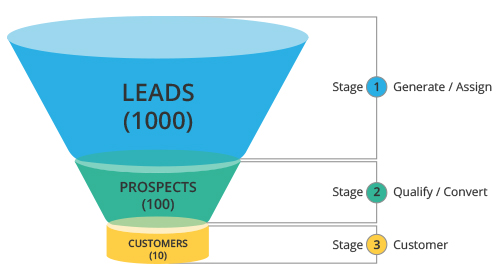
Zoho: Lead Funnel example
You don't have any problem with inbound leads. In fact, there are so many, it makes you want to not care about all these marginally interested people who want to check out your website. But, you should care if your industry has a finite number of prospective decision makers with budget authority.

After a lead converts to becoming a prospect, where the prospective buyer has expressed some sort of hand raising (e.g., downloading a white paper, signing up for a sales demo, setting up an appointment with a sales rep, or scheduling an on-site consult), that's when it gets tricky to a) define the handshake sign-off between marketing's lead nurturing (MQL) and sales' rationale for considering a prospect as a sales qualified lead (SQL).

In reality, many leads get stuck in the middle of the funnel. The only part where a marketer can really focus on first is the middle with tactics such as marketing automation to help further entice the customer to give out his/her BANT (budget, authority, need, and timing).

You can only write and deploy so many touchpoints before a prospect marks your communications as spam or simply unsubscribes even though they were so close (according to their lead score) to becoming a paid subscriber.

Home Depot: Gardening Club News

Home Depot's Gardening Club newsletter has always been a favorite of mine. This is where regional news really comes into play and why regional targeting of this type of content marketing really works. When I lived in California, it was sunny nearly all year and the overnight lows really never got below 40 degrees F. In the Pacific Northwest where we can have hail and snow as late as April, it's nice to see that this newsletter is aware of that and makes suggestions as to what can be planted at this time. It's a really good resource for both new and current subscribers. There's a lot going on in this basic spring email, and it is all relevant to the store, the brand, and the customer.

2014-02-19, Home Depot Garden Club email

Is offering a discount enough?

"Your mystery offer is waiting <checkmark symbol> it out". That was in my inbox this morning from Shutterfly. Thank goodness Google Mail rendered the symbol correctly; though I wonder how many customers got the question mark instead for that special character insertion. I would think that I am already a customer since I made a purchase earlier in the year and while Shutterfly might have marketing automation capabilities, whoever is managing how content is delivered to customers and prospects is doing it from a batch and blast perspective; which is okay if your company fits one of the following scenarios:
  • a consumer products oriented company with a high churn rate
  • customers respond better to discounts because you've conditioned them to expect it
  • your company is a market share leader in its industry, and you simply don't care about losing existing customers
  • your CEO dictates the marketing plan
  • your products are more of a commodity than a premium brand
Before and after purchasing from Shutterfly, I'd always gotten promotional emails and like most consumer emails they are spammy...meaning I get more than four per month. And to top that, all the discounts have been in the 40% to 50% range or free products (e.g., 12 free thank you cards, free photo magnet, free photo book, etc.). It makes me think that their loss-leader costs are minimal.

Take this Shutterfly email as an example. What do you see?
Shutterfly promo email from 2013-08-22

If you saw in the email preview screen that you only got up to 40% off for buying something from Shutterfly, you might just be in the 90% who would see just that. However, if you were really tuned into promotional offers, you'd see that it's up to 40% in addition to existing sale prices. Which did you see, the former or the latter response? If you saw the former, chances are you deleted the email since it didn't look any different than any other Shutterfly promotion. If you saw the latter, it might take you a second glance to see if you really saw the right offer and perhaps that is enough for you to click through. 

If this is a totally new offer (as in, this product pricing scenario has not been used with new customers), the offer needs to be called out in a color other than black text on construction yellow. The italicized black text is still more of the same. This is a callout for the "on top of sale prices" to be in a different color. It's hard to tell though if such an offer would really impact Shutterfly's media plan without having the production data. And, it is just one offer campaign out of dozens that Shutterfly runs each calendar quarter.

Best App Deployments of 2011

Google+ Hangouts enable free audio/visual conference calling with a group of up to 10 people. There's a 45-minute timer on the hangouts, so if you intend to be on it for longer than that, be sure there's a warm body who can let the app know that you're still around even when you're busy cooking up a holiday dinner. Check out the "Hangouts with extras" beta features. 

Amazon's Price Check lets shoppers at brick and mortar retailers use a smart device (iPhone, Android O/S) to enter the barcode of an item and purchase it from Amazon.com with a $5-off incentive. This takes comparison shopping to a whole new handheld level.

Move over iPen. Wacom has you beat with its Bamboo Paper app (for desktop or iPad) and its ergonomically-designed stylus for the iPad. Not only does it handle notetaking with handwriting recognition, it can also be used for sketching and presenting notes, ideas and sketches with others. Download these from Wacom's Bamboo Dock.

JPM Chase and Wells Fargo are among the front runners of the banking industry that are creating apps to make it easier for customers to transact with them using smartphone apps. Wells Fargo's Mobile Banking app allows users to check their available balances, view account activity, pay bills, make transfers between accounts or to other Wells Fargo customers, and locate the nearest Wells Fargo or Wachovia ATMs and office locations from an iPhone, iPod Touch or iPad. Chase QuickDeposit allows customers to deposit checks with an iPhone, iPad or Android device with just two camera clicks. Whatever online banking features customers already use to manage their finances with desktop systems, the momentum within the banking industry for secure, mobile banking apps is bound to increase significantly.

Happy Star Rewards (available on iPhone and Android platforms), a location-based rewards app by parent company CKE Restaurants, invites users to check in when they dine at either Carl's Jr or Hardee's. The first check in earns the user a spin on the "Wheel of Awesome" for a chance to win free or discounted food, gift cards, and merchandise from participating partners. Winners can immediately redeem the prize or within seven days. While the location-based app released early last year, it still totally one-ups Foursquare, Facebook Places, and other check in apps. File this one under retention marketing.

Runner-ups:

Unable to sell off its mobile operating system webOS and no longer a manufacturer of the tabletware that houses this code, HP's webOS and its support resources are now part of the open source community where devs can use and modify freely.

Popplet, a web-based collaborative mindmapping tool. Think of popples as little buckets containing text, photos, and whatever else people share online. Free version only allows you to edit one popplet and the paid version allows you to create unlimited popplet. Downsides: Flash-based for desktop computers, still in beta, clunky interface.

CarrierIQ's hidden app collects device performance data from millions of Android, Blackberry, and Nokia mobile phones. Is that really a bad thing? What R&D entity wouldn't want to know more about their users and how their devices are being used? It is a gray area in US wire tapping laws since CarrierIQ's app engages in passive wiretapping for monitoring/recording data traffic. Unless these class action lawsuits can prove that CarrierIQ deliberately altered the traffic with the app, there's really not much that any user can do about it besides buy a mobile phone that doesn't have CarrierIQ's rootkit installed such as a Windows 7 Phone. So it tracks location data, big deal. How else would a mobile device be able to triangulate the best celltower reception or allow a user to check into their favorite retail shop?