This is a nagging topic on the minds of a lot of marketers this year; in addition to making marketing automation work like a mad SQL (sales qualified lead) generating tool. With respect to direct, email, or online marketing, what seems commonplace to me as a marketer might not be apparent to others who have had mixed results with their campaigns. Let's start with a basic approach: email marketing.
Batch and blast works well for generalized content or for product announcements. But, for that personal touch, as in do it with customer service like you really care... try sending your customers a personalized, non-sales oriented email about a birthday, anniversary, or a special gift just for them.
Ask customers to engage with you in online conversations, participate on polls or surveys, or get feedback on their experiences. It doesn't hurt to ask for their input. What do you think about the new features we put into ___. How does your website redesign look?
When I ask other marketers how many touches they send out to their prospects and active customers, I get a variety of answers. The most I've heard of (including autoresponders from newsletter signups or web form submissions) on the B2B side is 15-20 touches per prospect per month. Ouch, I don't think I'd want to be on the receiving end without an unlimited data plan for my connected devices. This is when planning out content and using a scheduling calendar really helps when releasing time-delayed content. Some premium features of marketing platforms even offer limiters on how many times a lead or contact can be contacted within a set period of time. And, you can also manage frequency when setting up a demand automation funnel as well for handling MQLs and recycled SQLs.
And last of all, your prospects and customers are just like you and me. We have a finite amount of time to devote to activities like reading email; especially promotional or content that adds some richness to our daily lives. Be mindful of how (often) you send out content.
/stepping off the soapbox/
Shared Office Space
I'm a bit intrigued by the shared office workspace being pitched by PivotDesk at Seattle Tech Meetup. Seems to take the contract management and billing hassles out of subletting office space, coupled with the host office providing other services (utilities, high speed internet, conference room, etc) which might not defray actual overhead costs.

Certainly there are far more pros than cons for the Guest; I'm not sure what else the Host office gains out of this arrangement other than a monthly sublet fee paid to them.

Certainly there are far more pros than cons for the Guest; I'm not sure what else the Host office gains out of this arrangement other than a monthly sublet fee paid to them.

Above the Fold
Nearly every web and SEO expert will tell you that this concept simply does not matter anymore now that screen sizes have grown considerably and users subconsciously don't notice the effort it takes when swiping around on a tablet or other portable Internet-capable device. It is necessary under certain web conditions that may or may not be under your control in a web content management system. It is an archaic means of enticing people to buy a newspaper, where all the juicy content or eye-grabbing make-you-read-it-there stuff was on the top half of the front page. But have we, as humans, evolved enough to break away from generations and centuries of reading content this way? It was only natural when the web adopted this type of lure for its own viewers. Some viewers will scroll down if they find that content is usable and valuable to them.

I managed a corporate e-newsletter that, when printed, came out to be five pages long. A partner vendor had complained that I slotted their offer (a free Photoshop plug-in) at the bottom of the newsletter; and when it came down to metrics, they were pleased by the results (more than a thousand click-thrus to their website; the top offer by unique clicks for that newsletter issue). Feedback from other partners report similar successes. It's not where your content is on that page. If it is relevant to whoever is looking and speaks to their needs, it will sell.
Who does the content matter to? It depends on who you're trying to sell that content to. And by selling I don't mean an outright purchase, I'm talking about time and consideration of that content by a prospective user or customer. I had shifted content around putting our most relevant new content at the top of the newsletter, like a new product announcement, case studies, a new online community that we started to host and curate, followed by partner content, and then by partner offers. The perception here was to change how the newsletter was seen internally by the company. If I highlighted the awesome stuff the company was doing, then word-of-mouth would spread. Well, that was the idea anyways.
Is slotting all your valuable content above the 600px line the right design approach for your newsletter, landing page, or website? I have to say, err no insist, that it depends heavily on the audience you are trying to attract and how you intend to make a sale.
Seguetech.com had this interesting image about offers and the fold:

It'll work for most types of websites out there, from professional services to K-12 software to potluck blogs, etc.
I find all this mildly amusing considering that every site I've researched that suggests the contrary about the "above the fold" has their primary subscribe or call-to-action or contact us above the fold. It makes me think that above the fold is still very much relevant.
Read more?
Book Review: The Crowdfunding Bible
Crowdfunding is a popular means of starting up a business or funding a project. In 2011, $1.5 B was raised through crowdfunding and $2.8 B was projected to be raised in 2012. Equity-based crowdfunding, where a portion of the company's future profits are up for grabs, is becoming more prolific. The question that remains to be answered is how much funding can be raised without registered brokerage firms before the SEC steps in and regulates this type of financing activity.
This free ebook comes from Scott Steinberg, who is the author of "Crowdfunding Businesses and Startups: The Ultimate Guide", a Huffington Post article which is a harmless plug for the book. There's also an accompanying video.
Crowdfunding and crowdsourcing are not new models; but I have taken an added interest in it because there is quite a lack of business and marketing support for those who do get their projects or startups funded this way. I like how this book is structured and it has a whole section dedicated to questions that entrepreneurs need to be asking of not just their own projects but also the ones that were successfully funded. Even if you get funded it doesn't mean that your project will succeed with its deliverables.
It was also interesting to see how quickly funding can be eaten away by unforseen risks. The example posed in the book is of Warballoon Studios that raised $37k to make iOS and Android game Star Command.
What's good about the book is that it offers solid pre- and post-funding project planning ideas and tips for each stage of crowdfunding, from creating an effective video pitch to building effective rewards. The best part was the Q&A section of the entrepreneurs who got funded.
Read more?
VentureBeat's Kickstarter failures infographic (41% of projects fail, even when funded)
This free ebook comes from Scott Steinberg, who is the author of "Crowdfunding Businesses and Startups: The Ultimate Guide", a Huffington Post article which is a harmless plug for the book. There's also an accompanying video.
Crowdfunding and crowdsourcing are not new models; but I have taken an added interest in it because there is quite a lack of business and marketing support for those who do get their projects or startups funded this way. I like how this book is structured and it has a whole section dedicated to questions that entrepreneurs need to be asking of not just their own projects but also the ones that were successfully funded. Even if you get funded it doesn't mean that your project will succeed with its deliverables.
It was also interesting to see how quickly funding can be eaten away by unforseen risks. The example posed in the book is of Warballoon Studios that raised $37k to make iOS and Android game Star Command.
What's good about the book is that it offers solid pre- and post-funding project planning ideas and tips for each stage of crowdfunding, from creating an effective video pitch to building effective rewards. The best part was the Q&A section of the entrepreneurs who got funded.
Read more?
VentureBeat's Kickstarter failures infographic (41% of projects fail, even when funded)
Pre-populated Web Contact Forms
I don't know what's worse at the moment, being forced to register for each real estate website where I want to browse a listing or having fake contact data pre-populate when an online account is generated by an agency's contact management system. From time to time, I'll comp neighborhoods around where my rental is located to see if housing prices of the existing home supply (vs new housing starts) are rising, falling, or staying the same. The web contact form lead wall with Keller Williams is just one of those examples of a poorly thought out lead generation plan. I'm not sure why their web form thought I'm from NY, but it does. Unfortunately I have seen this type of web form behavior before where the back-end software captures and saves the contact info of the most recent transaction; in this case, a user from NY.
Here is an example of a pre-populated customer account that you probably don't want replicated with your own website:
And, to make it worse, you actually do have to check your account profile to see what email items the opt-in signs you up for because while there was only one checkbox to opt-in for email marketing, there were three options from KW. See below:

Surely, much success can be attributed to this lead gen program in terms of quantity of lead generated and number of validated email addresses that are added to one's in-house or partner email list. But, I'm not sure what they really mean by a trusted mortgage partner. There's also no double opt-in upon signing up, like a confirmation of an email address for starters. That's bending the opt-in rules a bit. Banks, insurance, and credit card companies do it all the time because they have subsidiaries or divisions that do partner-like activities. Also, there's no mention about a privacy policy or data usage policy on a user's account profile, or how to find out more info about it.
Here is an example of a pre-populated customer account that you probably don't want replicated with your own website:
 |
| Keller Williams: post-login from new account creation, user account profile |

It's unclear from the web page's source code if this is a home-grown web form or hosted by a third party provider. I'm not terribly inclined to check out other KW agency websites to test this out.
Snail Mail and Why We Love It
Why marketers love it is because it's a very well established mailing standard. Every property (and even those with just a box) has a postal address and you know that when spelled and annotated correctly, it has a 100% chance of getting delivered intact and mostly on time to the intended recipient, "to our neighbor", or "valued customer".
Why people love it is because it is an interactive communication piece with a tactile response. It's even better when it's personalized just for you; and, for the most part, it doesn't matter if it comes from a business or from a friend, although we like the latter part even better.
There are a lot of "standards" that just haven't died; although some who believe that everyone should be connected to everyone else online all the time want you to believe that it already has. The radio (118 yrs old). Fax machine (163 years, or for modern purposes 63 years). Libraries. Copiers. Telegrams. Land line telephones, etc.
Despite how traditional is trending against digital, according to the Direct Marketing Association's 2012 Response Rate report, the cost per order or lead acquisition costs were about the same regardless of the method used: direct mail ($51.40), postcard ($54.10), email ($55.24), and paid search ($52.58). Hmmm. Makes one wonder what's going on here.
It basically boils down to this:
Every marketing channel has its pros and cons, but what marketers and new entrants in the market need to be aware of is a) who you are trying to reach, and b) how much are you willing to spend on your campaign.
Why people love it is because it is an interactive communication piece with a tactile response. It's even better when it's personalized just for you; and, for the most part, it doesn't matter if it comes from a business or from a friend, although we like the latter part even better.
There are a lot of "standards" that just haven't died; although some who believe that everyone should be connected to everyone else online all the time want you to believe that it already has. The radio (118 yrs old). Fax machine (163 years, or for modern purposes 63 years). Libraries. Copiers. Telegrams. Land line telephones, etc.
Despite how traditional is trending against digital, according to the Direct Marketing Association's 2012 Response Rate report, the cost per order or lead acquisition costs were about the same regardless of the method used: direct mail ($51.40), postcard ($54.10), email ($55.24), and paid search ($52.58). Hmmm. Makes one wonder what's going on here.
It basically boils down to this:
Email
|
Mail
|
Phone
|
Lower response
|
Higher response
|
Highest response
|
Lower cost
|
Higher cost
|
Highest cost
|
Every marketing channel has its pros and cons, but what marketers and new entrants in the market need to be aware of is a) who you are trying to reach, and b) how much are you willing to spend on your campaign.
Foursquare Day
 |
| A Foursquare Visualization. Pretty cool looking, utterly useless |
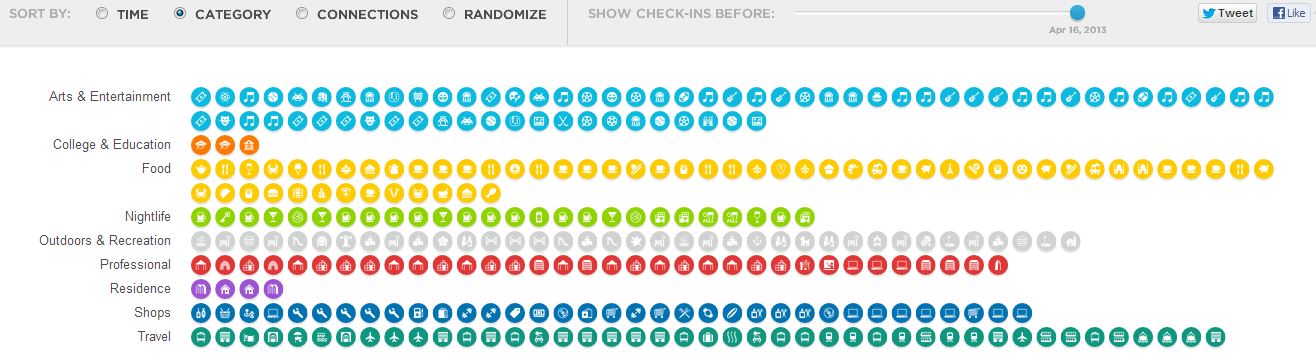 |
| Another Foursquare Visualization. This one shows quantity by venue type, with no indication if you've visited a place more than once. |
Subscribe to:
Posts (Atom)