Showing posts with label mobile advertising. Show all posts

Pre-Game Day Super Bowl Ads

I was served up an ad trailer of a game day ad by Toyota. And it was the feeblest 30 seconds of my day so far.  Part of the excitement and anticipation for the half-time show is to see what new spins on ad creatives that agencies and corporations have come up with, to laugh and be amused. 

This ad trailer already has more than 44k views. I imagine the email advertisement went to all current Toyota owners who are also registered subscribers. I can understand why marketing and sales would have chosen to run a preview of the ad; perhaps they can use early feedback to tweak the ad components or to test campaign tracking; but isn't that what Q/A testing is for? Or maybe they want to prep the audience for what looks like it will be an over-spent ad spot.

Anyhow. I don't see the point of wasting an existing customer's time to read an email to click through to a video hosted on YouTube for content that isn't even an entire ad. Ugh. And the micetype? Watch outtakes? Not even close. These are just clips of the same ad hastily pasted together.

The saddest part? There will be Super Bowl ads on game day from companies and organizations that lack deep-pocketed agency resources but will be able to pull off a good ad that drives home a relevant selling point and reasons why you should buy or invest in that company.

Foursquare Day

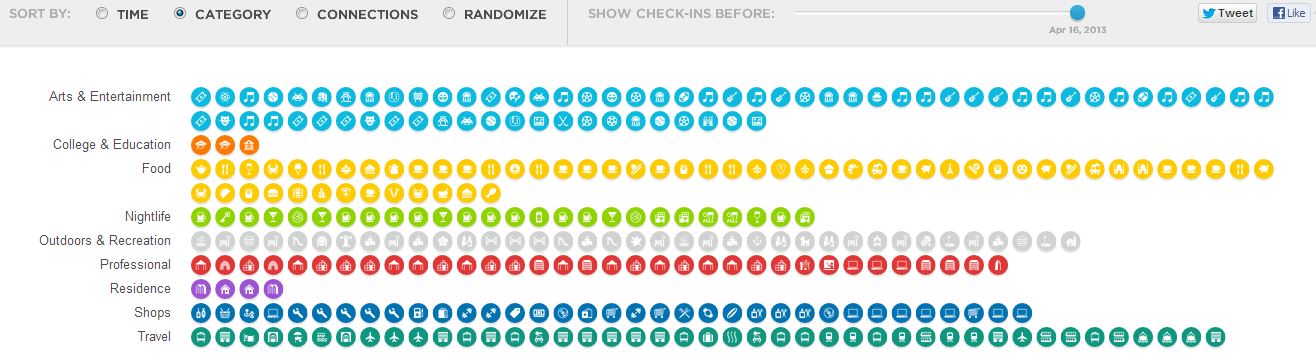
For those of you who may not know (or care), April 16 is Foursquare Day; largely an event promoted by mobile for Foursquare users to meet and mingle at various places. But, this post isn't about that. It's about their visualization tool that shows what you've done for a year. There are just four preset visualizations and they aren't all that helpful for anyone, including the user. If only I could download this or geographically see where I've been, or what cities I've been to have the highest concentration of unlocked badges. The Foursquare network is still growing and provides an alternate means of tracking hyperlocal ad redemption.
A Foursquare Visualization.
Pretty cool looking, utterly useless


Another Foursquare Visualization.
This one shows quantity by venue type,
with no indication if you've visited a place more than once.

Bring Your Own Device Strategy

Bring Your Own Device (BYOD) is an interesting customer acquisition strategy that is currently in use by T-Mobile, whether it is regarding a tablet, a SIM card mobile device, or other portable device such as a next-gen handheld GPS, wifi-enabled A/V, etc. The BYOD concept emerged just a few years ago and is gaining more traction among security software providers, as well as corporate and government work environments. 

By 2016, Gartner predicts that more than 1.6 billion smart mobile devices will be sold, two-thirds of the workforce will own a smartphone, and 40 percent of the workforce will be mobile. Mobile will change applications and how they are delivered.  By the end of the decade, more than 30 billion devices will be permanently connected (to the internet) and 150 billion will be occasionally connected. It will soon cost more not to monitor devices than to monitor them.

Apple's iAd

Since when does ownership of a mobile device entitle the manufacturer to broadcast third party ads to your service plan? Has something changed radically in the way technology handles multimedia that users can block out advertisements if they don't want to see it? And, if that isn't the case and this is rolled out to everyone who owns an iPhone or i-device, who pays for the additional bandwidth these ads are going to suck up? Obviously, the end-user if they don't have an unlimited bandwidth plan for their mobile device. 

The revenue model sounds great for Apple with its very high barrier to entry for those who want to advertise on the exclusive and closed system iAd network. 6.4 million iPhone subscribers in the US isn't paltry. It may not make the most sense or make the best use of online advertising budgets right now; but in time it could grow from being a mere goldfish to an invasive carp species in a few more years. This is just one channel in Apple's distribution network for content that leapfrogs beyond how traditional media is served up.

End-users already pay subscription fees for bandwidth for their mobile device, they are now (or soon will be) at the mercy of ad serving on a device that used to offer a more private space.
Where should marketers draw the line when it comes to exclusive ad networks?


Read more?

Related articles:
Number of iPhone subscribers, 07/2009