- Double points day (basically 4x points for a purchase, excluding tax)
- Buy item x and item y (and sometimes item z), and get 10, 20, 50, 75, or 125 extra points
- Buy any item three times for x-bonus points
- Buy any item on three (up to 5) consecutive days for x-point
Starbucks Rewards Ratio Changes Yet Again
Two things come to mind when I think about Starbucks' loyalty rewards: a) 3rd party rewards are getting expensive to fulfill, and b) customers are still gaming the reward system. But, on the latter point, it's because Starbucks allows such things to happen with their current reward system which includes tasks such as:

Which Part of the Funnel Should You Focus On
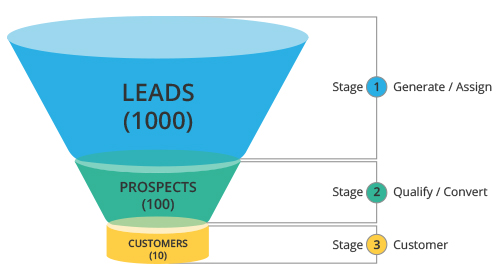
What do you have control over? If you don't have any input into how SEO/SEM works for your company or maybe inbound leads are driven by a 3rd party, you should probably not fret over the top of the funnel where potential buyers coming into your marketing+sales cycle.
Scenario:
Scenario:
 |
| Zoho: Lead Funnel example |
You don't have any problem with inbound leads. In fact, there are so many, it makes you want to not care about all these marginally interested people who want to check out your website. But, you should care if your industry has a finite number of prospective decision makers with budget authority.
After a lead converts to becoming a prospect, where the prospective buyer has expressed some sort of hand raising (e.g., downloading a white paper, signing up for a sales demo, setting up an appointment with a sales rep, or scheduling an on-site consult), that's when it gets tricky to a) define the handshake sign-off between marketing's lead nurturing (MQL) and sales' rationale for considering a prospect as a sales qualified lead (SQL).
In reality, many leads get stuck in the middle of the funnel. The only part where a marketer can really focus on first is the middle with tactics such as marketing automation to help further entice the customer to give out his/her BANT (budget, authority, need, and timing).
You can only write and deploy so many touchpoints before a prospect marks your communications as spam or simply unsubscribes even though they were so close (according to their lead score) to becoming a paid subscriber.
Hey Alexa, tell me about the weather...
I bought a 3rd generation Echo over the holidays because it was on sale. Though, I thought it would help me learn how to build an Alexa skill. I do not, however, feel comfortable about how it's listening all the time (when plugged in) and that it is not really a smart speaker at all. Nor how you can't connect Alexa units that belong to separate households of the same family.
It's sad to say that most of the 85,000 skills that Alexa now knows how to do, thanks to Amazon's holiday contest push for new skill submission, are one trick ponies.. that is to say, you ask Alexa to open <whatever> skill and it performs a single task (e.g., reads you news headlines, perform basic math but not compound algebra calculations, tells you what a single stock price is and not how your portfolio is performing). Boring.
From where we were with voice activated desktop computer commands to this incarnation of Alexa skills, we have gone backwards into the Dark Ages of technology potential. Thirty years ago we could already tell a computer to do one task skills (open a program, play music, open a website, play a game). Now Amazon, Google, Facebook, and Microsoft have unleashed what used to be in the domain of a software developer to anyone with the time and patience to read, write, and experiment.
Smart device? No, not really. My Alexa is still dumb as a brick.
It's sad to say that most of the 85,000 skills that Alexa now knows how to do, thanks to Amazon's holiday contest push for new skill submission, are one trick ponies.. that is to say, you ask Alexa to open <whatever> skill and it performs a single task (e.g., reads you news headlines, perform basic math but not compound algebra calculations, tells you what a single stock price is and not how your portfolio is performing). Boring.
From where we were with voice activated desktop computer commands to this incarnation of Alexa skills, we have gone backwards into the Dark Ages of technology potential. Thirty years ago we could already tell a computer to do one task skills (open a program, play music, open a website, play a game). Now Amazon, Google, Facebook, and Microsoft have unleashed what used to be in the domain of a software developer to anyone with the time and patience to read, write, and experiment.
Smart device? No, not really. My Alexa is still dumb as a brick.
Artificial Intelligence in Human Resource Management
That's the theme of this month's online conference from HR.com. If you thought the human part of human resources was broken for many companies, could AI be making it a better or worse experience for candidates, employers, and potential partners?
Marketing Technology Stack
Been seeing a lot of "marketing data science" positions appear in the Pacific Northwest on job boards lately and many of the job postings look like employer wish lists. The pay scale for such a mythical position varies as well, from entry level wages to all the way past $150K/year for larger, global firms. This is not the same as a Marketing Technology Stack (or, the tools and resources used that a marketer uses to deploy digital or mixed media campaigns).
A typical technology stack for marketers involves the following examples of software:
General Marketing Tool Categories
Is there a "data stack" for marketers? Yes and no. It depends on how complex and/or robust analytics data is. Are you reporting on enterprise data where you need to show campaign performance by sales region, territory, product groups, etc.? You might need something more than Excel's Pivot Charts and a flashy Powerpoint.
Is it possible to find a marketing technologist with a data analysis stack? It's possible, but not very likely. Though, marketing job requirements have been trending in this direction since the end of the great Recession (circa 2010) when people are expected to do more work with fewer resources. This trend was born out of industry need not because it actually helps companies make better pivots with marketing spend in their budgets.
Most companies want a software developer with marketing experience; while, a marketer with analytics experience doesn't offer the same level of technical skill (for software or methodology implementation). How often is a digital marketing (e.g., SEO specialist, email marketer, paid ad buyer) going to do their own campaign analysis and compare it to historic spend in order to create predictive models for future campaign spending?
What's in a typical data stack for marketers, if they are inclined towards software development?
A typical technology stack for marketers involves the following examples of software:
General Marketing Tool Categories
- Project Planning: Wrike, Trello, Asana, Basecamp
- Social Media / Group Social Media: HootSuite, SproutSocial, Buffer, MeetEdgar
- Social Listening: mention, talkwalker, buzzsumo, brandwatch
- SEO: ahrefs, moz, serps.com, SEMRush
- Video: vimeo, brightcove, wistia
- Content Management Systems (CMS): WordPress, HubSpot, contentful
- Email Marketing / Marketing Automation: MailChim, emma, aweber, GetResponse, Campaign Monitor, Pardot/ExactTarget
- Customer Relationship Management (CRM): salesforce, infusionsoft, HubSpot, Microsoft Dynamics
- Analytics: Google Analytics, kissmetrics, Adobe Analytics (formerly Omniture), Google Data Studio
Is there a "data stack" for marketers? Yes and no. It depends on how complex and/or robust analytics data is. Are you reporting on enterprise data where you need to show campaign performance by sales region, territory, product groups, etc.? You might need something more than Excel's Pivot Charts and a flashy Powerpoint.
Is it possible to find a marketing technologist with a data analysis stack? It's possible, but not very likely. Though, marketing job requirements have been trending in this direction since the end of the great Recession (circa 2010) when people are expected to do more work with fewer resources. This trend was born out of industry need not because it actually helps companies make better pivots with marketing spend in their budgets.
Most companies want a software developer with marketing experience; while, a marketer with analytics experience doesn't offer the same level of technical skill (for software or methodology implementation). How often is a digital marketing (e.g., SEO specialist, email marketer, paid ad buyer) going to do their own campaign analysis and compare it to historic spend in order to create predictive models for future campaign spending?
What's in a typical data stack for marketers, if they are inclined towards software development?
- R or SPSS
- Python
- Tableau (for data visualization - makes pretty pictures from data)
- Excel
- Google Analytics / Google Data Studio
In my digital marketing career, how many times have any of these come up as tools for marketers to use while doing marketing campaign analysis? Tableau, and only at one company.
Startup Weekend: An organizer's recap
Startup Weekend Vancouver happened at the start of June. People came out from all across the west coast to attend, as far north as Vancouver, BC and as far south as San Luis Obispo, CA. I'd like to say that it was a blast and fun to put on this event but it wasn't. Like most non-profit events, we had a lot of moving parts and at one point had setup a GoFundMe page because we thought we had more expenses than actual revenue from sponsors and ticket sales. Fortunately we were in the black with some budget money leftover for future events.
Hello Alexa, part 2
It's been a while since I last posted about Amazon's Alexa being accessible through the Amazon retail shopping app. And while Amazon's generic web search is fine and comes nowhere near the voice-to-search recognition that Google search offers, Amazon is missing the point about monetizing the index system that they have for the millions of products listed on their shopping exchange.
Wouldn't it be better if instead of matching to keywords (mostly nouns) in a user's speech search, that Amazon served up relevant recommendations instead.
Say for example, you ask Alexa (in the Amazon app):
"recommended wines for dinner" or
"recommended red wines" or
"recommended fruity wines"
Alexa currently offers no recommended product searches for any of the wines or wineries that sell on Amazon. Well, it certainly can't recommend wines that's for sure. But it could if Amazon incorporated product label text, certified wine reviews, or wine manufacturer descriptions in what can be searched. The words "recommend" and "recommended" are not in Alexa's lexicon of search knowledge. Perhaps this is too advanced a concept for Amazon's AI.
You can still just say "red wine" or "white wine" and those options will show up with valid results in the Amazon app.
Voice searching the Amazon product engine should be no different than typing in the search query.
The results are mixed, however.
You can say "services for window washing near me" and Amazon's app will show for "Hire a Window Cleaner" (Amazon Home Services) as the top result. That's spot on. The third result (same screen on a smartphone) shows "Window Cleaning" (Amazon Home Services), also a valid result to what I was voice searching for.
Maybe this is a phased rollout for voice search queries.
Wouldn't it be better if instead of matching to keywords (mostly nouns) in a user's speech search, that Amazon served up relevant recommendations instead.
Say for example, you ask Alexa (in the Amazon app):
"recommended wines for dinner" or
"recommended red wines" or
"recommended fruity wines"
Alexa currently offers no recommended product searches for any of the wines or wineries that sell on Amazon. Well, it certainly can't recommend wines that's for sure. But it could if Amazon incorporated product label text, certified wine reviews, or wine manufacturer descriptions in what can be searched. The words "recommend" and "recommended" are not in Alexa's lexicon of search knowledge. Perhaps this is too advanced a concept for Amazon's AI.
You can still just say "red wine" or "white wine" and those options will show up with valid results in the Amazon app.
Voice searching the Amazon product engine should be no different than typing in the search query.
The results are mixed, however.
You can say "services for window washing near me" and Amazon's app will show for "Hire a Window Cleaner" (Amazon Home Services) as the top result. That's spot on. The third result (same screen on a smartphone) shows "Window Cleaning" (Amazon Home Services), also a valid result to what I was voice searching for.
Maybe this is a phased rollout for voice search queries.
Subscribe to:
Posts (Atom)