5 Things to Look for in Your Bitly Stats

Mid-year I created a Twitter account (@SerenaHsiOS, ~700 followers) to push out elearning links since it didn't seem like the right venue to push them out my food-themed Twitter account (@nwfood). There are two stats from the Bitly dashboard that I find most curious. The first is the country domain referrer and the second is how users find my tweet--and only 15% them find it through Twitter.

Like most people, I just use Bitly as a link shortener. I know it has link stats and that once you create a bitlink, it can never be deleted (maybe archived these days). And with a mobile device and social sharing permissions, I can use Bitly to push out links to either Twitter account through Bitly with no extra logins required. I can even format the layout of the tweet.

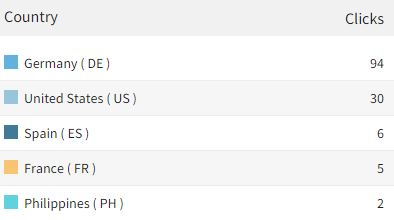
This to me is very strange, considering that I only broadcast business and elearning story links through non-food Twitter account. Let's tackle country referrer first. Here is the last 30-ish days from my Bitly dashboard:

2015-12 Last 30 Days - Bitlinks on @SerenaHsiOS - Country Domain
What in the world?? Why is engagement so high from Germany if my primary follower audience is US-based? I have no answer for this just yet.

The next dashboard shows me how a user got to my feed:
2015-12 Last 30 Days - Bitlinks on @SerenaHsiOS - Refer Type
Even more puzzling is the grouping for the first bucket. What makes me concerned about the validity of this data is that when I look at the list for my top tweets, according to the Bitly dashboard, no tweet has received more than 5 likes. And, on top of that.. how do you suppose impressions are calculated? I would have expected the top two stats to be reversed. How are my tweets being picked up if not through Twitter itself?

2015-12 Twitter Dashboard @SerenaHsiOS
Between Bitly and Twitter, my social analytics dashboards make no sense -- because my followers/following is so small (fewer than 1k each).

Year-end Post

I feel I should write something insightful, but alas, nothing really comes to mind.


Happy Holidays and Happy New Year!

(...and watch out for fire monkeys slinging poo...)

Banner Blindness

Banner blindness was first coined by Benway and Lane of Rice University in a 1998 study on website usability. The study looked at external ad banners and internal navigational ad banners; and found that users skipped over the ads when scrolling through a page and that the traditional method of making large, flashy ads did little to impact interaction by a web user. I should also note that there were only six participants in this study and it was done 17 years ago. If marketers are aware of such an impact, why are so few ads being seen by humans? You'd think that we would have engineered a way for ads to seem more relevant than the web content on a page.

I responded to a Twitter survey earlier today and one of the questions asked if I had seen a tweet or ad about Batman v. Superman, and I hadn't, even though I use Twitter on multiple devices. In fact, I really do have a hard time remembering advertising on Twitter, if it even happens at all.

And, it's not just me.

In a 2013 study about banner blindness, nearly 85% of consumers reported not remembering the last banner ad they saw; and those that did, a mere 2.8% thought they saw something relevant to them.

If I speculate about how the desktop-to-mobile experience is evolving, I'd say that banner blindness will significantly affect how Facebook's news feed works with consumers just skimming over content. Brands and advertisers don't just have to contend with the quirks of Facebook promoted content now they also have to worry about not reaching their intended targets.


Lowes.com Default Store Local Ad

The other top competitor in the Home Improvement space is Lowes. I thought I'd take a peek at their site nav as well between what the site thinks is my local store (based on browser history) and what happens when I try to look at the local ads.

Lowes.com - Default Store Location Based on Browser
As it turns out, there are no local ads for the default local store-based-on-browser history and an interstitial message briefly shows up saying there are no ads for the default local store before redirecting to the default local store ad, in Lowes' case, is a store in North Carolina.

Lowes.com - Weekly Ads of the Browser-Based Location
As you can see in this example, Lowes doesn't have their act together either. If you really wanted to rollout a national ad campaign, you should have a national ad and then add-on with whatever the region dictates, in terms of plants appropriate to the region's season and climate zones.

Home Depot: A bad UX update

Well, that could have gone better. It seems as though HomeDepot.com has rolled out of a site navigation redesign and somewhere along the way, zip codes and local stores has gotten all f'd up. Maybe their license for the 3rd party vendor that handles it expired or something. Not only do my bookmarked local store pages go somewhere other than the local store page, but when I try to find my local store in southwest Washington.

If I am searching for a store in Vancouver, WA, don't you suppose that the first listing should be a store in Vancouver, WA; instead, Home Depot's store listing service shows you the closest store to the map location of "Vancouver, WA", in this example, is Jantzen Beach, OREGON.

WTF. I can't even set a local store. It keeps defaulting back to Beaverton, OR. 

Here's what I'm doing:

Go to: HomeDepot.com
Click onto: Store Finder or Change Store
Input: local zip code or city/state

You'd think that UX would be this simple.

What the nav system spits out for results, isn't even correct! Ok. I think I picked my store. It even shows up in green. The link for In-Store Layout is just a PDF of the store's layout. This link mapping is fine and it brings up the right store and store label.
Home Depot store finder - My Store will appear in Green when selected.
You think that session cookies would be in place, but sadly, they are not.

However, after selecting a location as "My Store", click onto the link for "Local Ad". 

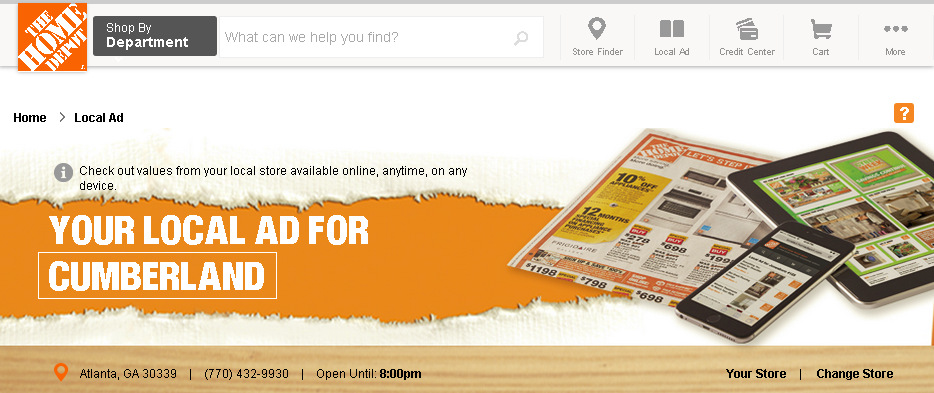
Here's what I get:

Local Ad Link Error: The page that loads AFTER choosing a store
from the Store Finder, and selecting LOCAL AD

How do you f--- up with Atlanta's Cumberland store showing up? A bad UX update. That's how.

And then, when I use the top page nav, guess what? The page forgets about my store, and navigates me to.. wait for it.. Beaverton, OR. This is probably because my browser thinks I am in Portland. But, I just told the website that my local store is E Vancouver.

HomeDepot.com Home page AFTER selecting my local store

But wait, there's more! It looks to me like these are two entirely different applications and they are not talking to each other all that well: Store Finder and Local Ads. I can tell these are separate apps when I look at their mapping directions. My store is still green lit, but the map still wants to navigate to Beaverton.
Ad-hoc Flyers

This is probably one of the silliest things I have ever done while on the road at a tradeshow. I created a flyer based off a Pardot landing page. Then had it printed overnight and ready for pickup at a convention center's FedEx Office. It's a tad expensive to print flyers like this, but in a pinch it will do.
Landing Page as a Booth Flyer?


Event-Tracking.com

Still looking under the hood, but at referral traffic.

The usual suspects are there: feedly, social sharing, etc.

Except, this one:


612 visits of the 865 MTD (70% of total blog traffic) or so are attributed to this referral page.

It suggests that something is terribly amiss with the conversion from classic GA to universal GA, or with my inept implementation of the universal GA javascript on my various blog properties.

/sigh