Showing posts with label linkedin. Show all posts

Microsoft doesn't just acquire companies

$26.2 B looks reasonable for the patents and trademarks that Microsoft is acquiring with its latest purchase. Why build software yourself when you can buy it cheaper from someone else? Besides, this is an acquisition war for enterprise software and LinkedIn is not just a software platform for recruiters and job seekers. A stockpile of cash doesn't do anyone any good if it just sits around collecting interest. $26.2 is a price that no one being acquired would complain about. You might even consider this purchase a waste if you were writing for Forbes. But, that is not the case. Here's what Microsoft also gets with that deal.

CXO talent:
  • Jeff Weiner is retained as CEO of subsidiary LinkedIn (ranks at #5 on Glassdoor's Highest Rated CEOs in 2016) - how does that saying go? Employees quit leaders, not companies (via TalentCulture). This is a retention tactic used by Warren Buffett, who often lets senior management stay at the acquired company if that company is managed well.
LinkedIn's Patents (source) - only adds to Microsoft's girth of patents and trademark holdings

LinkedIn's acquisitions (source):
  • 15 Digg patents (purchased for a mere $4 M)
  • mspoke
  • ChoiceVendor
  • CardMunch
  • Connected
  • IndexTank
  • Rapportive
  • SlideShare
  • Pulse
  • Bright
  • Newsle
  • Bizo
  • Careerify
  • Refresh.io
  • Lynda.com
  • Fliptop
  • Connectifier

The other cake trimmings:
  • This is the primary feature that sets LinkedIn apart: it allows online services to be marketed to users within a network. Many companies struggle with this concept and network-wide implementation.
  • LinkedIn's app portfolio - mobile authentication, user feature that allows attachments from mobile phones, user feature that effortlessly allows users of any status (basic, premium) to connect with any user on LinkedIn's primary platform. Apps include:
    • LinkedIn - a lite version of the LinkedIn website for users, a basic user lookup tool
    • LinkedIn Lookup - a bio-hacker for professionals for skills and experience
    • Lynda.com - eLearning on the go
    • LinkedIn SlideShare - shareable presentations
    • LinkedIn Groups - professional and industry interest networking
    • LinkedIn Pulse - business news
    • (premium) LinkedIn Recruiter
    • (premium) LinkedIn Sales Naviator - the sales lead engine for selling on LinkedIn
    • (premium) LinkedIn Elevate - reputation building by content sharing
  • The LinkedIn Brand - the web/mobile properties under the LinkedIn umbrella have mostly been well managed, both from an integration and public relations perspective; nothing bad can happen from adding this to the Microsoft portfolio, unless the integration between the subsidiary and the parent fails to mesh
The acquisition makes sense. Who else could have purchased LinkedIn? Any of the top 50 companies amassing stockpiles of cash.

And as for LinkedIn's 9,200 employees? I expect nearly all of them to get laid off at some point as Microsoft sheds dead weight from overlapping operations it wasn't keen on picking up with this purchase.

Contact Curation

Once a year I glean through my entire roster contacts on LinkedIn and push people off the island. It's not a long list and I do like to stay in contact with people. Perhaps this is due to the marketer in me. Usually it's people who have done one of the following things:

  • Not made a post, comment, or share by social media, email, phone or mail
  • Recruiters who have not done the above
  • Connections I have never met in real life who do the above
The exception to this are those I've added to my LinkedIn roster because they have a skill or expertise I want to know more about (e.g., I met this Caucasian guy who is fluent in Mandarin whose role is to mitigate between domestic US and foreign subsidiaries.. that is very, very cool), I want to meet them some day, or their company makes something awesome and meeting their CEO or founders would make a great memory; or I met them in person and they would make a fantastic connection.

It's hard to tell who you can connect to based on LinkedIn settings. I don't mind writing referrals for people who are connected to me to their 2nd degree contacts. I do mind getting pinged by invite hoarders. People whose claim to fame on LinkedIn is 5000+ contacts on LinkedIn. I think you're just setting yourself up for a lot of spam if you do that. Just how many people connections do you need to become a rain maker? Would these connections want to refer business to you?

Having never made a LinkedIn article post, it bugs me that my profile has 500+ followers, most of whom I'm not even connected to on a 1st degree basis. I'm not sure how LinkedIn came up with this feature. Maybe you automatically follow someone if you comment on their shared links or posts.

LinkedIn: Gone Phishin'

One of the problems with automated platform emails is never knowing what you're going to get on the receiving end. Sure, there are plenty of people on my contact roster whose first name is "John" and others with the last name of "Smith", but the "John Smith" character simply does not exist. Maybe someone at LinkedIn thought it was clever way to add connections this way. What makes it weirder is the language of the email which reads:

"Your contact, John Smith, just joined LinkedIn
Help welcome John and get connected"
2014-03-12, mobile screenshot
of LinkedIn notifications email

If he's already a contact, presumably farmed from the LinkedIn ecosystem, wouldn't he by default be in my network already? It makes me think this is a phising email since I don't know any John Smiths. And none exist in my LinkedIn connections nor among the apps that share contact data with LinkedIn.

LinkedIn: Profile Suggestions

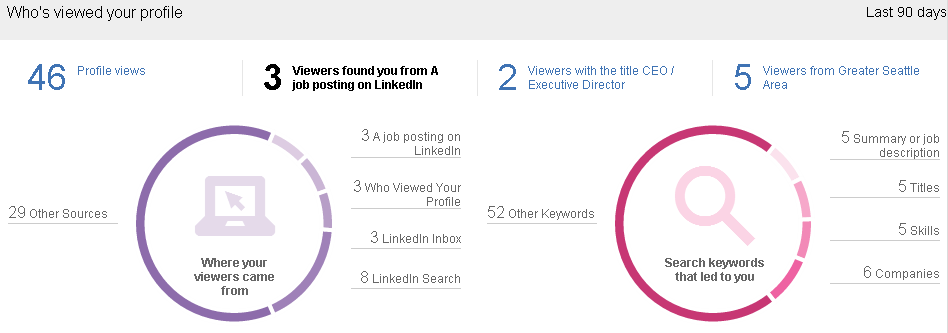
At this rate, I won't even have to think about what to add to my profile to get the extended network to click onto it. Looks like a new "analytics" rollout from LinkedIn that shows you a little bit more about "Who's viewed your profile". Seriously, I don't think I'd get "up to 3%" more views per click that I add to the profile. Seems like a lot of the suggested skills aren't skills but keyword phrases used by my peers in the management consulting industry. This is almost as bad as getting a skill recommendation from someone who behaves online as a 2nd or 3rd degree connection. What do you think?
2014-02-12, LinkedIn Profile View Suggestions
The view for updated stats available to basic accounts has been upgraded. This is what it looks like now instead of the former tiny line chart and a raw number count.
2014-02-12, LinkedIn Profile Views Dashboard

LinkedIn and User Privacy

Perhaps you were among the 100 million users who got automatically opted into LinkedIn's ad network, or perhaps you read about it through some social media site. Not terribly interested in having your demographics used within ad targeting? Here's how to opt-out:
  1. Click on your name on your LinkedIn homepage (upper right corner). On the drop-down menu, select "Settings"
  2. From the “Settings” page, select “Account”
  3. In the column next to “Account”, click “Manage Social Advertising”
  4. Un-check the box next to “LinkedIn may use my name, photo in social advertising”
You could also turn on/off Enhanced Advertising, Partner InMail, data sharing with 3rd party applications, invitations to participate in research, and LinkedIn announcements.

I'm a bit surprised that LinkedIn didn't have any Home dashboard messaging about the mass opt-in change to user settings. At least users have the ability to opt in and out when they want to. Options are always good. We make better decisions when presented with many options instead of few or none.

Private Company Valuation

Two of my grad skool classes (econ & finance) taught this topic as part of its curriculum and both professors had us neophytes look at quantitative data with respect to publicly traded companies; but what if you are trying to do a valuation of a privately held company. Can you train your intuition to be as good as the eons of financial valuations done by the professionals?

What do we know about a company? Does it matter who founded it or who their VC backers are? Does it matter more if end users actually like the products and services offered? And, how would you even know if it's the right time to buy? What can LinkedIn do that similar competitors cannot? What is their competitive advantage?

First things first. I haven't invested in the stock I'm about to talk about in this post. I thought about it quite a bit, but a SaaS vendor that is relatively new on the block and as one that embraces emerging technologies, it falls outside my personal criteria for investing in new stocks. I have been a basic end user since they launched; and I heard about it from a colleague. Word of mouth marketing is pretty powerful stuff. These days, it's nearly mandatory for business students at the undergrad or graduate level to have a LinkedIn profile. I have a user profile where I allow some public (non-login) access to; though you can see much more if you are also a member of the site. And, for the most part, for those of you without a dedicated site for your resume or portfolio, this is a good business networking site to connect with or show others in the industry or prospective markets what you are all about.

The site serves three distinct markets: human resource professionals, business end-users, and advertisers that want to market products/services to site users. For business networking sites, LinkedIn has few competitors using the freemium model, such as Germany's Xing (65 million members) or France's Viadeo (30 million members). Bloomberg, D&B, or Hoovers often provide basic data and company overviews. If we looked purely at the site being for mid- and executive level job seeker members, the site also competes for pocketshare with Execunet and TheLadders.

Over the last couple years, LinkedIn had been quietly rolling out web technology advancements and key partnerships with app add-ons, relevant ones that help sell a user's online business persona. Google AdSense ads have also recently appeared on the site too; though, they appear to be there to help the site pay for itself rather than be direct attempts at forming partnerships with key advertisers (though, the site has that feature too).

The target offering price of $45 is fair. It's the starved market that has pushed the price above $100/share. Is it sustainable at that price? Probably not, but investors don't care. If you're looking for a rational explanation for the jump in price, you won't find one on talk radio or the financial news hour on television. Investing isn't about rational decisions, it's based on GRIEF (according to one of my professors): Greed (Return, Income, Earnings) Fear. Anyhow, back to the topic at hand.

Companies typically go public to raise their status (more media coverage, more marketing), attract new customers, fund business expansions or R&D initiatives, and/or pay off existing debt and early-stage investors. Private company valuations are done to help sell the company, raise additional capital from investors, for a management buyout, for estate planning, for creating an ESOP plan (employee stock ownership plan), or for tax purposes.

To valuate a private company, one method is to look at the pre-IPO or SEC filings of existing competitors that are publicly traded or who are open about their earnings and revenues. The statements that privately-held companies make in these filings shed the best possible light into who they are and what they stand for; and are pretty good browsing for those who want to launch a similar concept or business.

A second method is to look at quantitative figures such as beta (how much market risk when compared to others in the industry), cash flow, or market capitalization (share price x outstanding shares). Here is a decent overview of how to calculate beta and total risk; this PDF link comes from Aswath Damodaran's NYU page.

A third method is to use Inc Magazine's valuation calculator or site resources. Industry data is already neatly aggregated for users to see sector averages for different types of businesses; and from the options of the drop-down box for industry, it is based on standard industry classification (SIC) categories, or its more modern counterpart NAICS. The interactive visual calculator looks at multiple quantitative data points such as industry median sales and revenues, net sales, gross profit, EBIT (earnings before income and taxes), EBITDA (earnings before interest, taxes, depreciation and amortization), discretionary earnings (operating profit, owner compensation, and noncash charges), and BVIC (book value of invested capital).

There are a lot more strategies out there beyond the top three listed here. To make an informed decision about whether or not to buy the stock of a privately-held company, you'll have to engage in more than one method of valuation.